
A Health Production Case Study
How a Self-Funded Employer Achieved a Controlled Diabetes Population, Bent the Cost Curve, and Sustained Results with Northwind Clinical Blueprints®
A mid-size municipal utility with 2,600+ eligible members deployed Northwind’s proprietary Diabetes Clinical Blueprint® — a high-touch, pharmacist-led chronic disease management program integrated directly into their pharmacy benefit. Three years in, the results validate a core premise: when you invest in sustained clinical engagement, financial results follow.
Industry Leading Results
Over the course of the program, this client achieved clinical outcomes that most employers only read about, along with financial results that justify every dollar of program investment.
Costs Came Down. Significantly.
Rebates paid to the client in 2024, 100% passed through
Documented coupon savings in 2024
Return on every dollar invested in coupon program
Member Rx cost share (down from 16% in 2023)
Members Got Healthier. Measurably.
of members with follow-up A1c are at goal
reached A1c below 7%.
Member retention across both cohorts
Engagement rate among members with a diabetes Rx
Total members served since 2023
Members who have reversed to normal or pre-diabetes A1c
Prescriptions reduced or discontinued due to improved health
Decrease in PMPY diabetes costs since 2022
The Challenge
The client entered the program in 2023 with a growing diabetes problem and a cost trajectory that wasn’t sustainable.
367 members carried a diabetes diagnosis. Nearly a quarter joined the Clinical Blueprint with an A1c over 8, the clinical threshold for unstable, high-risk disease. 63% were classified as obese. Diabetes had become the plan’s single largest therapeutic spend driver: Mounjaro alone accounted for $1.19M in 2024 plan costs, and antidiabetics as a class consumed $2.54M, the top spend category by a wide margin.
The plan’s total pharmacy investment was rising year over year: $5.1M in 2023, $6.0M in 2024. Plan Paid PMPM jumped 32% year-over-year. Specialty drugs, which now represent 44% of plan spend, were compounding the pressure. The cost of inaction was measurable and accelerating.
Key Concerns
- A rapidly rising diabetes population with above-average disease severity at program entry.
- GLP-1 utilization at scale with limited clinical oversight or appropriateness review.
- Specialty drug spend growing faster than membership, without corresponding health improvement.
- High rates of medication non-compliance, a documented pattern when cost burdens are unaddressed.
- No integrated mechanism to connect pharmacy data, clinical engagement, and outcome tracking.
An Alarming Trendline Before Northwind’s PBM
2022
$838,052
Total diabetes plan spend
$227,372
Member contribution
258
Members with diabetes Rx
Humalog
Top product
2023
$1,380,381
Total diabetes plan spend (net rebates)
$201,918
Member contribution
275
Members with diabetes Rx
Mounjaro (market entry year)
Top product
2024
$1,815,266
Total diabetes plan spend
$104,273
Member contribution
303
Members with diabetes Rx
Mounjaro
Top product
The critical finding:
Despite rising prevalence (the diabetes population grew from 258 to 303 members over four years), the total cost of diabetes care in 2024 was lower than in 2022, before Northwind. That benchmark doesn’t just account for Blueprint participants. It accounts for the entire plan’s diabetes population. The program is having an impact large enough to move the aggregate number.
The Approach
Northwind Health operates at the intersection of three disciplines most health plans treat as separate: Pharmacy Benefit Management, Chronic Disease Management, and Acquisition Cost Index® pricing transparency. Bringing all three to bear on a single population isn’t just efficient. It’s transformative.
The Diabetes Clinical Blueprint® wrapped around each member with diabetes, providing free CGM equipment, pharmacist consultations, health coaching, quarterly A1c tracking, and direct intervention when a member’s numbers started to drift. Every touchpoint was designed to keep members engaged, not just enrolled.
The program was built around two goals:
- Produce measurable, sustained health outcomes that compound over time.
- Use transparency-first contracting (ACI pricing, 100% rebate pass-through) to fund the investment in clinical engagement.
What Members Say
The diabetes program this employer and Northwind provides has really been a game changer for me. I have lost 25 lbs and my A1C has dropped from mid 8’s to mid 6’s. That’s a big difference dropping 2 points all because I’m able to get the medicine and equipment my doctor has prescribed for me and is available at no cost thanks to the employer program.
I could not be more pleased with the Northwind Diabetes Blueprint program. A HUGE financial burden has been lifted. I no longer have sleepless nights wondering how I’m going to afford all of my medications. My A1C has gone from 13.1 to 6.7. I have been able to stop taking some of my diabetes medications. I have lost 40+ lbs and I feel better than I have in ten years.
Member Stories
These aren’t hypotheticals. These are members in the program — and what happened when they had real support.
From 13 to 6: A Controlled A1c and a Lifted Burden
A member entered the program with an A1c of 13, deeply in the uncontrolled range, and the monthly cost of managing their diabetes through conventional channels was running into the hundreds of dollars. Through the Blueprint, they were taken off Metformin and two of three insulins, dropped their A1c to 6, and lost more than 50 pounds, maintaining the loss for nearly a year.
They now manage their diabetes with Mounjaro once weekly and a Dexcom CGM, both covered through the program. Access, not willpower, had been the barrier.
Key Wins
- A1c reduced from 13.0 to 6.0
- Removed from Metformin and two of three insulins
- 50+ pounds lost and sustained for nearly one year
- Monthly medication cost reduced to near-zero through program access

Reversing the Trajectory: Off Blood Pressure Medication After Years
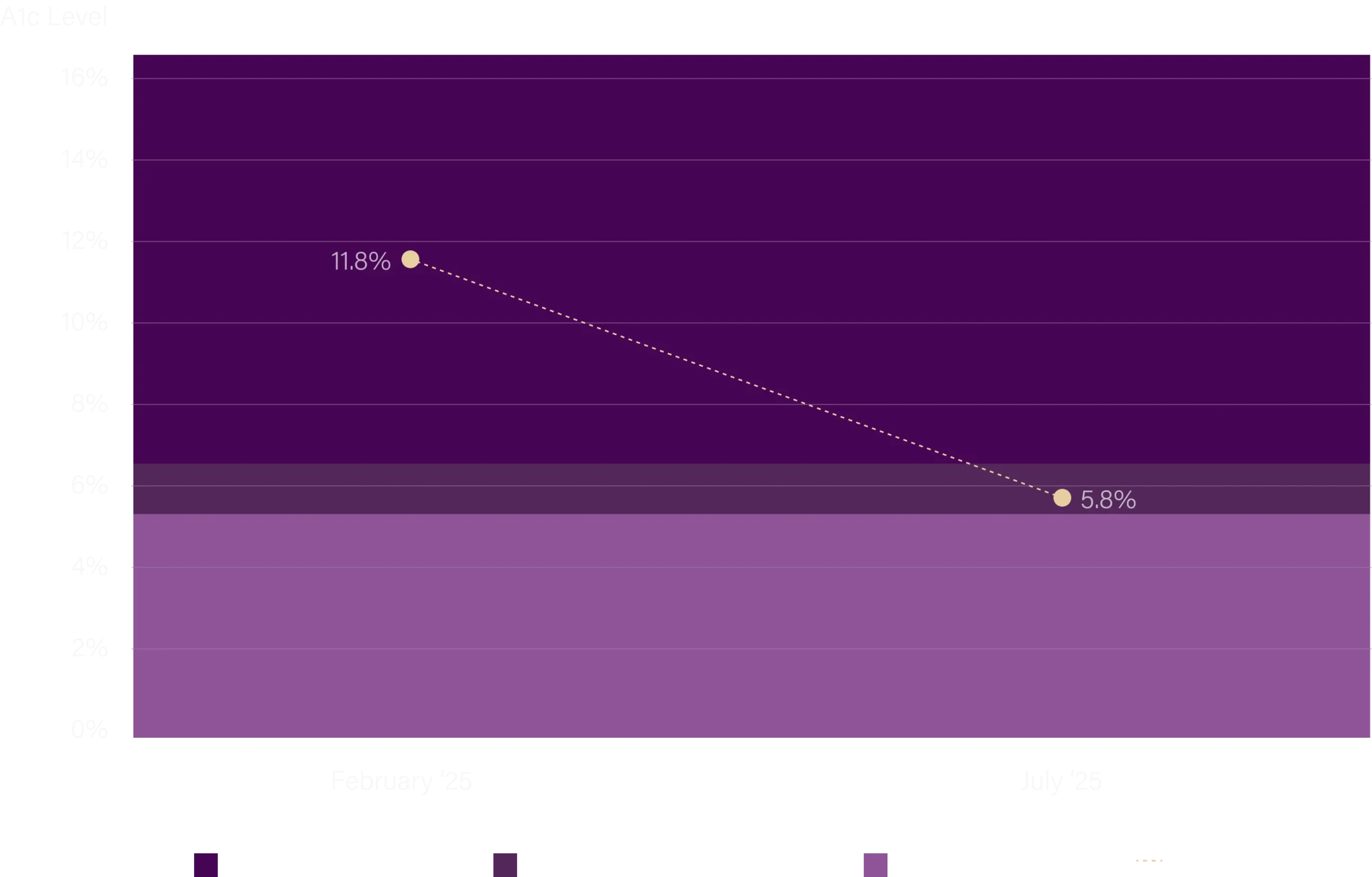
A member whose A1c had reached approximately 13 entered the program and, with consistent pharmacist engagement and medication optimization, brought their number to 6.8. Their physician removed them from blood pressure medication for the first time in years. They also lost 28 pounds.
This is the halo effect Katherine Lurk, VP of Clinical Strategies, describes: “Disease stability and maintaining control is just as important as the rapid management of extreme cases.” The Blueprint catches people before they become emergencies and keeps them from returning to one.
A1c 11.8
February
A1c 5.8%
July
Key Wins
- A1c reduced from approximately 13.0 to 6.8
- Blood pressure medications discontinued
- 28 pounds lost
- Ongoing quarterly pharmacist and health coach engagement
The bottom line.
The client’s cost for the care of members with diabetes was lower in 2024 than in 2022, before Northwind. That’s not a result of fewer people with diabetes. It’s a result of 184 people getting the right care, staying engaged, and not needing the emergency room, the inpatient bed, or the escalating specialist cycle that unmanaged chronic disease produces.
The program also generated goodwill, an asset that doesn’t appear on the benefits ledger but matters. Members credit their employer, not Northwind, with the change in their health. That attribution is intentional. The Blueprint is designed to make the employer the hero.
As Katherine Lurk put it: “This case study demonstrates the long game: the value of clinical intervention and disease stability over time. Just because something isn’t costly today doesn’t mean it won’t become costly tomorrow.”

