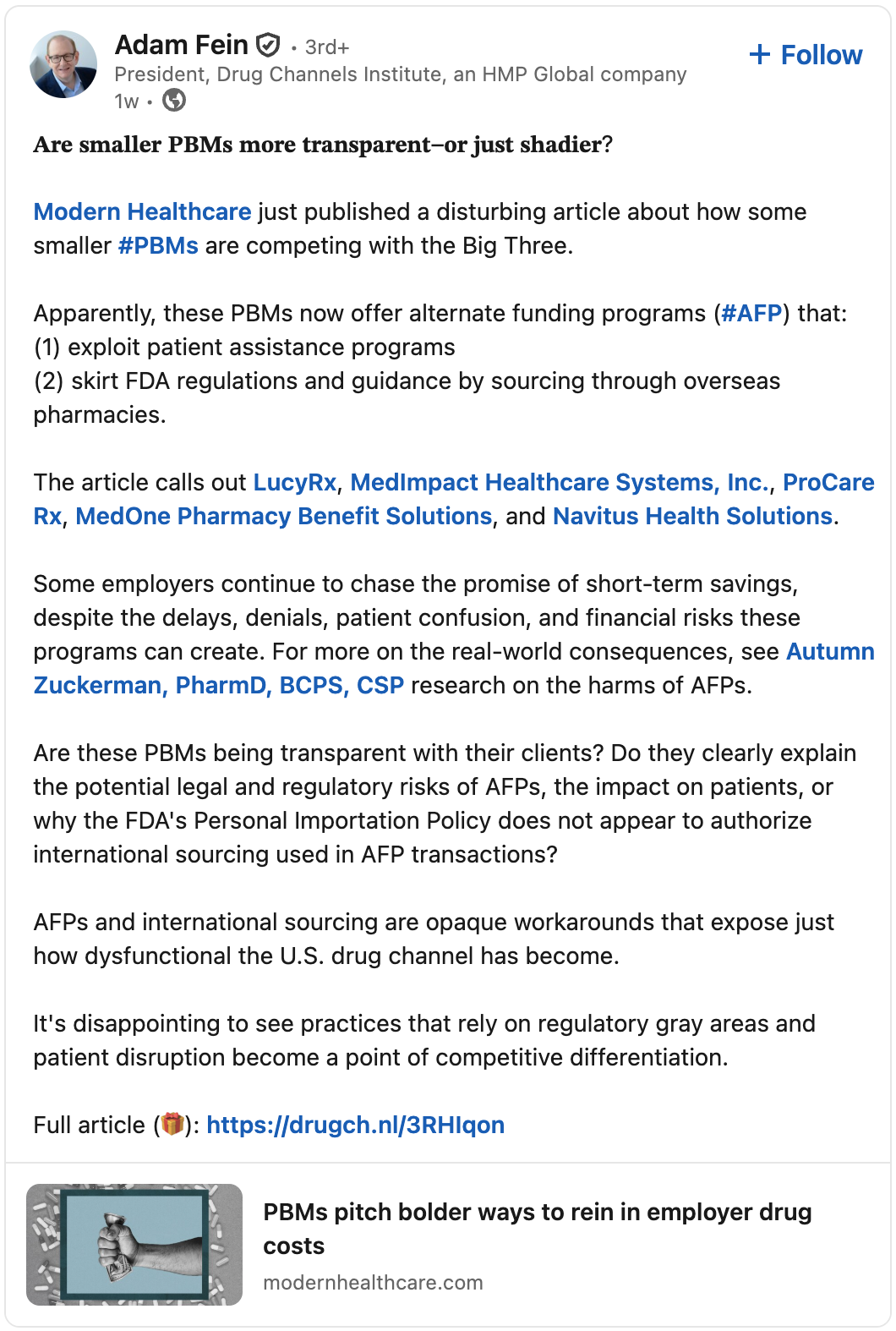

Our thanks to Adam Fein and the Drug Channels Institute, an HMP Global Company for this LinkedIn post — one that continues a long tradition of providing tremendous education and insight for the Institute’s followers. We agree that employers should look carefully beyond the promise of short-term savings. The legal, economic, strategic, and member experience implications of alternate funding programs and international sourcing deserve thoughtful scrutiny.
International sourcing and AFPs can introduce more than regulatory uncertainty. They often create fragmented care experiences, treatment delays, administrative complexity, patient confusion, inconsistent medication availability and disruption to the trusted relationship between patients and their care teams. Even when they produce lower unit costs, they can also shift costs elsewhere; increased provider burden, lower member satisfaction, reduced adherence and ultimately poorer health outcomes. That said, we believe there is a different way.
For too long, our industry has focused on winning the unit cost battle. While unit cost certainly matters, it is only one piece of the equation—and arguably not the most important one. Sustainable success comes from helping people get the right care at the right time while removing the financial, social, educational and behavioral barriers that prevent them from achieving better health.
The employers seeing the strongest long-term results are shifting from cost containment tactics to value creation strategies. They are investing in member engagement, supporting informed clinical decision-making, improving access and measuring success through outcomes—not simply discounts.
At the end of the day, no matter how low the cost, the most expensive medication is the one that was not needed.
When we help people avoid unnecessary therapies, improve adherence to appropriate treatments and create a better healthcare experience, everyone benefits—employees, employers, providers and the healthcare system as a whole. There is a better path to sustainable results—one built on transparency, trust, measurable outcomes and human flourishing rather than regulatory workarounds and short-term savings.